
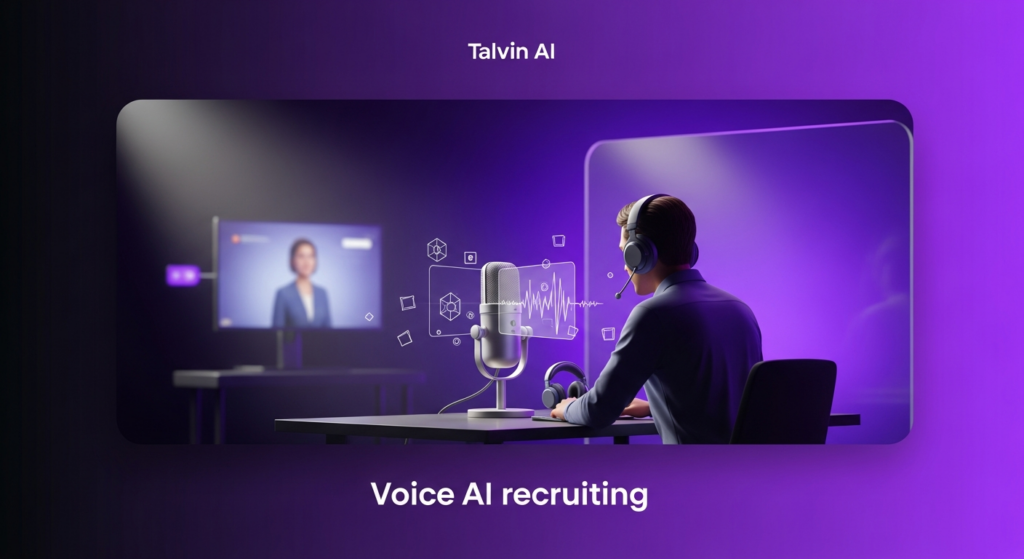
Why APAC Employers Are Switching from Video to Voice AI
Voice AI recruiting is gaining ground across APAC — and the shift isn’t driven by novelty. It’s driven by results. Hiring teams in Singapore, Malaysia, Sri Lanka, and Australia are replacing static video interview tools with two-way adaptive voice AI because the old approach was slow, inconsistent, and poorly suited to the region’s linguistic diversity. When a conglomerate like Janashakthi Group can screen 150 candidates in 5 days — a process that previously took 4–5 weeks — the business case becomes difficult to ignore.
This post breaks down why video-first screening tools have struggled in the APAC context, what voice AI actually does differently, and what early adopters are reporting from the ground.
The Problem With Video Interviews in APAC Hiring
Video interview platforms were largely designed for Western markets — built around stable broadband, native English speakers, and candidates who are comfortable performing to a camera alone. In the APAC context, each of those assumptions creates friction.
One-way video puts the burden on the candidate
Most video screening tools ask candidates to record themselves answering pre-set questions. There’s no interviewer, no follow-up, and no opportunity to clarify intent. The candidate either nails the recording or starts over — and the hiring team receives a stack of videos to manually review. That’s not automation. That’s just asynchronous admin.
The experience also creates drop-off risk. Some candidates — especially those applying for their first professional role, or those less accustomed to self-recording — find the format uncomfortable enough to abandon the process. In high-volume APAC hiring, where you may be sourcing from a broad candidate pool across multiple countries, candidate drop-off is a real cost.
Static questions can’t verify what actually matters
A pre-recorded video interview is only as good as its question set. If a candidate gives a rehearsed answer to a scripted question, you’ve learned how well they prepared — not how they actually think. There’s no follow-up. No curveball. No way to probe beyond the surface.
Industry data supports the scale of this problem: over 70% of screening interviews are conducted with ultimately unqualified candidates. That’s not a technology failure — it’s a structural one. Static question formats can’t separate polished presentation from genuine competence.
Non-native English speakers are disadvantaged by video AI scoring
Several video AI platforms use facial expression analysis, tone scoring, and pronunciation evaluation as proxy signals for candidate quality. For a hiring market as linguistically diverse as APAC — where candidates may speak English as a second or third language, and where regional accents vary significantly — this approach introduces bias rather than reducing it. Multiple verified customer reviews of video-centric platforms document transcription failures and inaccurate scoring for non-native English speakers. That’s a structural mismatch for any tool deployed at scale in this region.
What Voice AI Recruiting Actually Does Differently
Voice AI recruiting isn’t a voice-recorded version of the same one-way video format. When built correctly, it’s a fundamentally different modality — a real-time, two-way conversation driven by an AI agent that adapts to what the candidate says.
Two-way adaptive conversation, not scripted Q&A
Talvin’s AI agent, Sally, conducts real-time voice dialogues with candidates. The conversation is fully adaptive — Sally asks contextual follow-up questions based on what the candidate says, and can introduce deliberate curveballs to test situational judgment and verify technical claims. Recruiters configure the depth of probing per question: Low, Medium, or High — so the interview goes deep where it matters and moves efficiently elsewhere.
This means a candidate can’t simply rehearse five answers and coast through. The interview is responsive, dynamic, and significantly harder to game than a static question set. It’s also more natural — most candidates describe the experience as a conversation rather than a performance.
Hearing how candidates think, not just what they say
In any hiring decision, communication and reasoning ability are among the hardest things to assess from a CV. Voice AI captures both in real time. How a candidate structures an answer under pressure, how they recover when challenged, whether their reasoning holds up when followed — these signals emerge naturally in a voice conversation in a way they rarely do in written screening.
Non-technical recruiters particularly benefit. Talvin’s AI candidate screening empowers HR generalists to confidently vet candidates for technical roles — because Sally handles the probing, and the transcript analysis surfaces what mattered.
Optional video capture — more data, not less
Voice AI doesn’t mean giving up visual signals. With Talvin, the hiring organisation chooses whether to enable video capture of the candidate. Most do — because seeing how a candidate presents themselves adds data points that voice alone can’t provide: visual presentation, legitimacy verification, and cultural fit signals. The combination of adaptive voice conversation and optional video capture gives recruiters more information than either modality alone.
This is a meaningful distinction. Talvin is not a voice-only platform. It is a two-way adaptive voice AI platform with optional video capture — a combination that outperforms one-way video tools on both depth of insight and candidate experience.
APAC-localised from the ground up
Talvin’s voice agent is engineered specifically for the APAC market — measured pacing, neutral and easy-to-understand accents, and support for the linguistic diversity of the region. The goal isn’t just functional accuracy; it’s reducing candidate anxiety. A candidate who can follow the interview comfortably will give you better signal than one who is struggling to parse a thick Western accent at speed.
This localisation extends to the economic model. Talvin charges per minute of AI interview usage — not per seat or per interview — making it viable for the high-volume, cost-conscious hiring environments common across APAC. See the full pricing breakdown here.
What Early APAC Adopters Are Reporting
The clearest evidence for the voice AI shift comes from organisations that have already made it.
Janashakthi Group — 150 candidates screened in 5 days
Janashakthi Group, a Sri Lankan conglomerate, ran high-volume screening across multiple roles using Talvin. A process that previously took 4–5 weeks manually was completed in 5 days. The speed wasn’t achieved by lowering the quality bar — it was achieved by removing the manual bottleneck entirely.
JXG — 460 applications, 10 shortlisted, 100% data-driven
JXG used Talvin for their Management Trainee Program 2026. With 460+ applications to process, 96 automated AI interviews were completed and the top 2% of talent was identified — producing a final shortlist of 10 candidates for their “Spartan Summit” final round.
Rehan Perera, Senior Assistant Manager of Human Resources at JXG, described the outcome directly:
“Beyond the efficiency, the platform ensured our process remained 100% transparent and data-driven. We are very pleased with the quality of the candidates identified through this digital-first approach.”
Sampath Bank PLC — enterprise compliance cleared
For organisations in regulated industries, the question isn’t just whether voice AI works — it’s whether it meets security and compliance standards rigorous enough for enterprise rollout. Sampath Bank PLC, one of Sri Lanka’s major financial institutions, ran an initial pilot with Talvin and subsequently secured Board IT approval for enterprise-wide implementation. That approval process, in a financial institution, is not a formality.
Code94 Labs — 488 resumes to 15 shortlisted in one week
Beenali Dangalle, Hiring Manager at Code94 Labs, documented one of the most cited outcomes in Talvin’s customer base: 488 resumes processed, 15 candidates selected for final interviews, in one week. Screening time cut by 80%. Her description: “like having 10 recruiters working around the clock.”
These aren’t edge cases. They’re consistent with what happens when you remove the manual screening bottleneck from a high-volume pipeline. Learn more about how AI candidate screening works.
Voice AI vs Video Interview: A Direct Comparison
| Dimension | One-Way Video Interview | Voice AI (Talvin) |
|---|---|---|
| Interview modality | Candidate records to camera alone | Real-time two-way adaptive voice conversation |
| Follow-up questions | None — fixed question set | Contextual, adaptive, configurable depth |
| Candidate experience | Performance-style, drop-off risk | Conversational — 4.2/5 avg satisfaction |
| Non-native speaker accuracy | Documented AI scoring failures | Engineered for APAC linguistic diversity |
| Video capture | Core feature (mandatory) | Optional — hiring org decides |
| Probing technical skills | Limited to scripted questions | Dynamic curveballs and drill-down per question |
| Runs 24/7 | Yes | Yes — hundreds of simultaneous interviews |
| Job simulations | Not available | Available via Job Tryouts |
| ATS integration | Varies by platform | Live: Ashby, Greenhouse, Workday, Zapier |
Where Job Tryouts Extend the Advantage Further
For customer-facing roles — hospitality, retail, food and beverage, sales — the limitation of any interview format is that it measures interview performance, not job performance. Talvin’s Job Tryouts address this directly.
Candidates are placed inside realistic, role-specific scenarios powered by AI Persona Technology. They navigate a difficult customer interaction, resolve a technical objection, or handle a workplace situation — in real time, with a dynamic AI character responding to what they actually say. The result is a demonstrated performance signal, not a self-reported one.
Companies using Job Tryouts report a 30–45% reduction in employee turnover. The feature was recognised internationally — Talvin placed in the top 10 globally at the VAPI Global Voice AI Hackathon specifically for this innovation.
For offshore hiring teams managing high-volume frontline roles, Job Tryouts represent a meaningful step beyond what any video screening tool currently offers. See how Talvin handles offshore hiring specifically.
The Practical Case for Making the Switch
The shift from video to voice AI in APAC isn’t about chasing a trend. It’s about closing a gap between what hiring teams need — speed, depth, consistency, and linguistic accuracy at volume — and what legacy video tools were designed to deliver.
If your team is running 25+ hires per quarter, the manual screening bottleneck is already costing you candidates. Top-tier talent in APAC is hired within days. A screening process that takes weeks means you’re competing for second-choice candidates, not first.
Voice AI recruiting, done with a genuinely adaptive platform and APAC-native design, removes that bottleneck without replacing your existing ATS or overhauling your workflow. It sits on top of what you already use, handles the volume, and returns a shortlist — with structured data, candidate transcripts, and scoring you can actually explain to a hiring manager.
That’s the shift. And the organisations making it are reporting the results above.
Frequently Asked Questions
What is voice AI recruiting and how is it different from a video interview?
Voice AI recruiting uses an AI agent to conduct real-time, two-way voice conversations with candidates — adapting questions based on responses, probing for depth, and assessing how candidates think under pressure. Video interviews typically ask candidates to record themselves answering pre-set questions with no follow-up. Voice AI is conversational; video screening is performative.
Can voice AI interviews also capture video of the candidate?
Yes — with Talvin, video capture is optional and configured by the hiring organisation, not the candidate. Most hiring teams choose to enable it because it adds data points: visual presentation, candidate legitimacy verification, and cultural fit signals. The combination of adaptive voice AI and optional video gives recruiters more information than either approach alone.
How does voice AI handle non-native English speakers in APAC?
This is one of the core design challenges voice AI platforms have to solve for the APAC market. Talvin’s AI agent, Sally, is engineered specifically for APAC — with measured pacing and neutral, easy-to-understand accents designed to reduce anxiety and improve accuracy across the region’s linguistic diversity. Generic Western-built platforms have documented transcription and scoring failures for non-native speakers.
How long does a voice AI interview take, and what does it cost?
Interview length varies by role and configuration. Talvin charges per minute of AI interview usage — not per interview or per seat. Plans start at $175/month for 50 minutes of interview time. This per-minute model is designed to make voice AI economically viable for high-volume APAC hiring without pricing SMBs out. See full pricing.
What kind of results have APAC companies seen from voice AI screening?
Janashakthi Group screened 150 candidates in 5 days — a process that previously took 4–5 weeks. JXG processed 460+ applications and produced a shortlisted pool of 10 elite candidates for their Management Trainee Program, with the process described as 100% transparent and data-driven. Code94 Labs went from 488 resumes to 15 final-round candidates in one week, cutting screening time by 80%.
Does voice AI integrate with existing ATS platforms?
Yes. Talvin integrates live with Ashby, Greenhouse, Workday, and Zapier. It fetches candidates from your existing ATS, triggers voice AI interviews automatically, handles all invites and reminders, and returns a shortlisted set of candidates — all within your existing workflow. No rip-and-replace required.
Is voice AI suitable for technical roles where non-HR recruiters need to assess skills?
This is one of the strongest use cases. Talvin’s Sally asks contextual follow-up questions and deliberate curveballs, with recruiters able to configure drill-down depth per question (Low / Medium / High). Non-technical HR staff can confidently vet candidates for technical roles because the AI handles the probing and the transcript analysis surfaces the signal.
Ready to See Voice AI Recruiting in Action?
If your team is hiring at volume in APAC and video screening has been slowing you down, Talvin AI is built for exactly this problem. Two-way adaptive voice interviews, optional video capture, APAC-localised design, and integration with the ATS you already use.
Book a demo → See how Talvin handles your specific hiring volume, role types, and regional requirements.
Or explore the product further:
AI Candidate Screening · Job Tryouts · Offshore Hiring · Pricing