
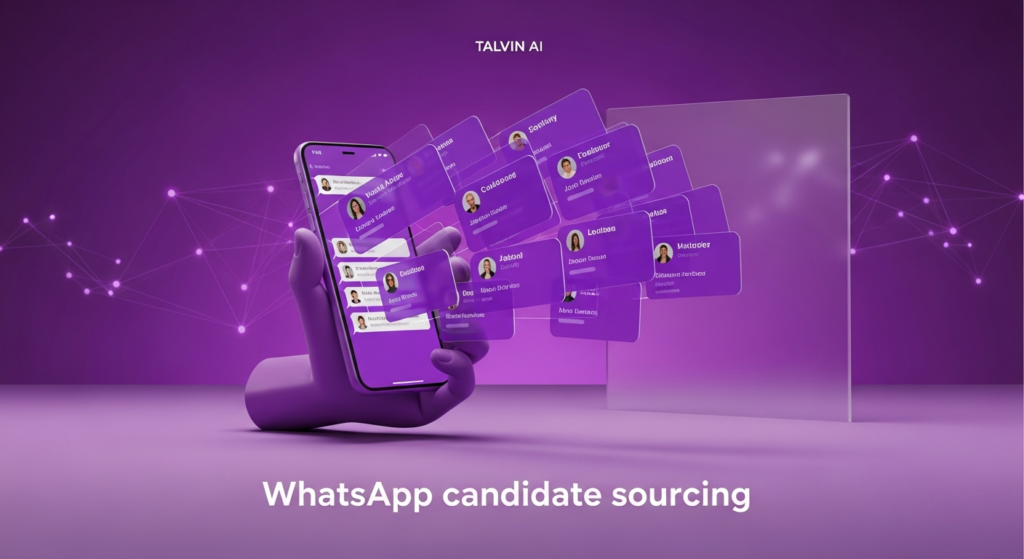
How to Use WhatsApp to Source Candidates at Scale
WhatsApp candidate sourcing is the practice of using WhatsApp — and increasingly AI-powered WhatsApp automation — to reach, qualify, and engage job candidates at scale. For hiring teams operating in APAC, where WhatsApp is the dominant personal communication channel across Sri Lanka, India, Malaysia, Indonesia, and Vietnam, it is often the fastest path to a qualified shortlist.
The problem with traditional sourcing in high-volume environments is not the talent. It is the friction. Candidates ignore email. LinkedIn InMail response rates for frontline and BPO roles are low. Job boards generate volume but not signal. WhatsApp is where people actually respond — quickly, on their own terms, without the formality that slows everything else down.
This guide covers how to build a WhatsApp sourcing process that works at scale, what separates a conversational AI approach from a broadcast message approach, and why the next step after WhatsApp engagement needs to be a structured assessment — not another round of manual screening.
Why WhatsApp Works for Candidate Sourcing in APAC
In most APAC markets, WhatsApp is not just a messaging app — it is the primary communication layer for daily life. Candidates applying for customer support, BPO, operations, and sales roles are already on it. They check it before email. They respond to it faster than any other channel.
For recruiters filling contact center, offshore delivery center, or high-volume frontline roles, this creates a practical advantage: you can reach candidates within minutes of sourcing them, on a channel they trust, without asking them to download a new app or log into a portal.
The sourcing bottleneck in high-volume APAC hiring is rarely finding candidates. It is qualifying them quickly enough that the best ones do not accept another offer while you are still working through your inbox. Offshore hiring teams in particular face this pressure — top candidates in markets like Sri Lanka and Malaysia are often fielding multiple outreach messages simultaneously, and response speed matters.
The Three Modes of WhatsApp Candidate Sourcing
Not all WhatsApp sourcing is the same. There are three distinct approaches, each with different outputs and limitations.
1. Broadcast Messaging (Manual)
The simplest form: a recruiter sends a job notification to a list of saved contacts or a WhatsApp group. Fast to execute, zero infrastructure required. The limitation is obvious — it is one-way, there is no qualification, and at scale it becomes unmanageable. Responses land in a recruiter’s personal inbox and have to be handled manually.
2. Template-Based Outreach via WhatsApp Business API
A step up from broadcast. Using the WhatsApp Business API, teams can send structured messages to opted-in candidates at volume, with basic personalisation (name, role, location). This works well for initial outreach and reminders. The gap is still qualification — the candidate responds, and a human still needs to handle what comes back.
3. Conversational AI Sourcing on WhatsApp
The most capable approach, and the one that changes the economics of sourcing at scale. Here, an AI agent conducts a two-way conversation with the candidate on WhatsApp — asking about their goals, motivations, experience, and availability — and builds a structured candidate profile from the responses. No recruiter time is spent until the candidate has already been pre-qualified.
This is the model Talvin AI is building with its WhatsApp Sourcing and Matchmaking feature, targeted for release in Q2 2026. The core idea: meet candidates on the platform they already use, and surface High-Value Signals — motivations, career goals, soft skills — that a CV cannot show.
What High-Value Signals Mean in Practice
A resume tells you where someone worked and what their job title was. It does not tell you why they left, what kind of environment they thrive in, or whether their long-term goals align with the role you are trying to fill.
WhatsApp-based conversational sourcing creates the space to ask these questions naturally, in a channel that feels low-stakes to the candidate. When the conversation is handled by an AI agent rather than a recruiter, candidates tend to answer more honestly — there is less performance pressure than in a formal interview, and less social awkwardness than responding to a recruiter they have never met.
The signals that matter most for roles like customer support, BPO operations, and contact center work — communication clarity, motivation, reliability signals, career trajectory — can all be surfaced in a well-designed WhatsApp conversation before a single recruiter minute is spent.
For offshore hiring specifically, this is significant. When you are sourcing candidates across multiple cities or regions simultaneously, an AI that can run hundreds of these conversations in parallel — 24 hours a day, without a timezone constraint — changes what is operationally possible.
How to Build a WhatsApp Sourcing Process That Scales
Whether you are using manual outreach, WhatsApp Business API, or an AI-powered tool, the structural logic of an effective WhatsApp sourcing workflow is the same.
Step 1 — Define Your Opt-In Source
WhatsApp sourcing requires a contacted, opted-in candidate list. Common sources: inbound job board applicants who have provided a phone number, referral networks, career fair sign-ups, or candidates who have previously engaged with your brand. Cold outreach on WhatsApp without prior consent is not compliant with WhatsApp’s Business Policy and should be avoided.
Step 2 — Design Your Opening Message
The first message has one job: get a response. Keep it specific (mention the role and location), keep it short (under 60 words), and make the reply action obvious. A good opening message does not ask the candidate to do much — it just asks if they are open to a conversation.
Step 3 — Run the Qualification Conversation
For manual or template-based approaches, this is where a recruiter takes over. For AI-powered sourcing, the agent handles this entirely — asking about experience, motivations, availability, and any role-specific criteria. The conversation should feel natural, not like a form disguised as a chat.
The key design principle: ask questions that a CV cannot answer. Experience and qualifications can be verified later. What you want at this stage is signal about fit, motivation, and communication quality.
Step 4 — Score and Prioritise
Once the conversation is complete, candidates should be ranked or scored based on the responses collected. In a manual process, a recruiter does this judgment call. In an AI-powered process, the system builds a structured profile and flags the candidates worth advancing — before a human sees a single message.
Step 5 — Move Qualified Candidates to a Structured Interview
WhatsApp sourcing surfaces candidates worth talking to. It does not replace a structured competency assessment. The next step for any candidate who clears the sourcing stage should be a proper AI voice interview — where their communication, reasoning, and role-specific skills can be evaluated consistently and at depth.
This is where AI candidate screening picks up. A conversational WhatsApp exchange gives you motivation and availability signals. A structured voice interview gives you evidence of how someone actually thinks, communicates, and handles pressure. You need both.
The Volume Problem: Why Manual WhatsApp Sourcing Breaks Down
The appeal of WhatsApp sourcing is immediacy. The problem with manual WhatsApp sourcing at scale is that immediacy disappears fast.
When you are sourcing for a BPO operation that needs to hire 50 customer support agents per month, or an offshore delivery center standing up a new team of 30 developers, the WhatsApp inbox becomes unmanageable within days. Responses arrive at different times. Candidates drop off mid-conversation. Follow-ups get missed. The recruiter who was supposed to be moving faster is now drowning in chat threads.
The fix is not more recruiters. It is automating the repetitive parts of the conversation — the qualification questions, the reminders for candidates who have gone quiet, the scoring — while keeping a human in the loop for the decisions that actually require judgment.
Recruiters who have moved to AI-assisted screening report spending significantly less time on initial candidate contact. The 70% reduction in time spent on unqualified candidates that Talvin’s AI screening delivers at the interview stage applies upstream too: the value of AI in sourcing is eliminating the conversations that should never reach a recruiter’s desk.
WhatsApp Sourcing for BPO and Contact Center Hiring
BPO and contact center hiring has specific characteristics that make WhatsApp sourcing particularly effective.
First, the candidate profile: frontline BPO candidates are almost universally active WhatsApp users. In Sri Lanka, India, Malaysia, and the Philippines, WhatsApp is the default. Email-first outreach for this segment consistently underperforms.
Second, the volume: BPO operations often need to hire cohorts, not individuals. A campaign approach — reaching hundreds of opted-in candidates simultaneously with a consistent message — is exactly what WhatsApp Business API and AI-powered sourcing tools are designed for.
Third, the speed requirement: BPO clients often have hard ramp dates. A new project requires 40 agents trained and live by a specific date. That leaves no room for a sourcing process that takes two weeks to produce a shortlist.
In the Janashakthi Group pilot, Talvin screened 150 candidates in 5 days — a process that previously took 4 to 5 weeks manually. That kind of compression only happens when sourcing and screening are both running on automated processes, not when one half of the funnel is still dependent on manual recruiter time.
Privacy and Compliance Considerations
Any WhatsApp-based candidate engagement process needs to handle consent and data properly. Key requirements:
- Opt-in only: Candidates must have explicitly consented to be contacted via WhatsApp before you message them. This is both a WhatsApp Business Policy requirement and a data privacy obligation in most APAC jurisdictions.
- Clear identification: Your first message must make clear who is contacting them and why. Ambiguous outreach erodes trust and reduces response rates.
- Data handling: Any candidate data collected through WhatsApp conversations — responses, profile information, contact details — needs to be stored securely and handled in accordance with applicable data protection laws. Talvin’s platform encrypts all candidate data at rest and in transit, and operates under a strict policy of never using personally identifiable information for model training.
- Right to withdraw: Candidates should be able to opt out of further contact at any point in the conversation.
For teams building offshore delivery centers in markets with their own data residency requirements — India’s DPDP Act, Malaysia’s PDPA, or Indonesia’s PDP Law — it is worth confirming that your WhatsApp sourcing tooling handles data in a compliant way before you scale.
Connecting WhatsApp Sourcing to Your Broader Hiring Stack
WhatsApp sourcing works best when it feeds directly into a structured screening process, not into a recruiter’s manual review queue.
The most effective setup: WhatsApp conversation surfaces qualified candidates → candidate profile and High-Value Signals are passed to your ATS or recruitment platform → an AI voice interview is triggered automatically → recruiter receives a shortlist with structured assessment data, not a pile of chat transcripts to read through.
Talvin integrates directly with Ashby, Greenhouse, Workday, and Zapier today, with Teamtailor in development. The WhatsApp sourcing feature being built for Q2 2026 is designed to feed directly into this same pipeline — so a candidate who starts a conversation on WhatsApp can be progressed to an AI voice interview and appear in your ATS shortlist without any manual handoff.
For teams hiring across offshore locations in APAC, this end-to-end automation is what makes the difference between a sourcing strategy and a sourcing operation.
FAQ: WhatsApp Candidate Sourcing
Can you legally source candidates on WhatsApp?
Yes, provided candidates have opted in to be contacted. Cold outreach to numbers you have not obtained consent for violates WhatsApp’s Business Policy. Build your candidate list from inbound applicants, referrals, or career fair sign-ups where contact details were voluntarily provided.
How does AI-powered WhatsApp sourcing work?
An AI agent conducts a two-way conversation with the candidate on WhatsApp, asking about their experience, motivations, availability, and role-relevant criteria. The responses are analysed to build a structured candidate profile. Qualified candidates are flagged for the next stage — typically a structured AI voice interview — without manual recruiter involvement at the sourcing stage.
Is WhatsApp sourcing effective for BPO and contact center hiring?
Yes. BPO and contact center candidates across APAC are active WhatsApp users, and the channel consistently outperforms email for response rates in this segment. The volume requirements of BPO hiring — often dozens of hires per month — also make it a natural fit for AI-automated WhatsApp campaigns that can run at scale without proportional recruiter time.
What is the difference between WhatsApp sourcing and a WhatsApp broadcast?
A broadcast is one-way — you send a message to many people and handle replies manually. AI-powered WhatsApp sourcing is conversational and two-way. The AI conducts a qualification dialogue with each candidate individually, collects structured responses, scores candidates, and passes qualified profiles to your recruitment platform automatically. The output of a broadcast is a list of replies. The output of AI-powered sourcing is a pre-qualified shortlist.
How does WhatsApp sourcing connect to AI candidate screening?
WhatsApp sourcing surfaces motivation and availability signals — information a CV cannot show. AI candidate screening, via structured voice interviews, assesses competency, communication quality, and role-specific skills. The two stages are complementary. WhatsApp narrows the field to candidates worth interviewing. AI voice interviews produce the evidence-based shortlist your hiring managers can act on. Used together, they compress a process that previously took weeks into days.
What roles benefit most from WhatsApp-based candidate sourcing?
High-volume frontline roles where speed-to-shortlist matters most: customer support, BPO operations, contact center agents, sales, retail, and hospitality. These are also roles where the candidate pool is large but quality varies significantly — making the qualification conversation at the sourcing stage particularly valuable.
Will Talvin AI support WhatsApp sourcing?
Yes. Talvin’s WhatsApp Sourcing and Matchmaking feature is planned for Q2 2026. It will enable AI-powered candidate conversations on WhatsApp, capture High-Value Signals beyond what a CV shows, and feed qualified candidates directly into Talvin’s AI voice interview pipeline and your connected ATS.
Start Screening Candidates Faster — Without Adding Headcount
WhatsApp candidate sourcing is one part of a faster hiring process. The other part is what happens after a candidate raises their hand — structured, consistent, AI-powered screening that runs 24/7 and delivers a shortlist your team can act on.
Talvin AI already handles that second stage for offshore hiring teams, BPO operators, and high-volume recruiters across APAC. The Janashakthi Group screened 150 candidates in 5 days. JXG processed 460 applications and identified the top 2% of talent for a competitive management trainee programme. Sampath Bank PLC completed a successful enterprise pilot and received Board IT approval for full rollout.
If you are hiring 25 or more people per quarter, the manual screening process is already the constraint. See how AI candidate screening works, explore Job Tryouts for customer-facing roles, or review Talvin’s pricing to understand the cost model.
Book a demo to see the full platform — including the WhatsApp sourcing roadmap — and find out how it fits your offshore or high-volume hiring operation.